By Good Life Zen
Life is precious.
But how to make the most of your life?
Here are fifty wise tips by readers on how to make the most of your time on earth.
1. It starts with being present and in the moment. Really appreciating the ‘small’ things in life – the smell of the morning, the feel of flannelette sheets, the warmth of a hug, the gift of a smile. And gratitude.
2. Follow your passion and you can create a life you can be proud of. The formula is really simple: find what makes you useful and happy.
3. Speak for those who have no voice. Make a difference in someone else’s life.
4. Help others, love fully, judge less, and take care of your body and your mind
5. Help your family and make sure they are okay.
6. Heal, if you need to be healed, forgive if you need to forgive, learn to love if that is your lesson.
7. Strive for a healthier, more purposeful life to get to the bones of existence.
8. Listen, breathe, and seek for the answers to who you are and what you are meant to do, as they are unique to all of us.
9. Face and accept pain and hurt, and to act in spite of fear.
10. Discover who we truly are – and live that life.
11. Use your own sense of self to look at others without judgement, see them with clear eyes and exercise compassion.
12. Remember to be present in each moment, see what beautiful thing is here now, no matter how small.
13. Take the time to really look carefully and contemplate.
14. Stay in the present and know we are where we are supposed to be.
15. Get to know the true nature of mind, seeing thoughts and emotions for what they really are – just clouds passing by in the sky.
16. Be in the present moment and extending love, kindness, and compassion to myself and others.
17. Take all your activities, beliefs, work, thoughts, feelings and contributions and make a gloriously messy patchwork of what’s true for you and your place in our earth community. Stitch the patchwork together with peaceful reflection and laughter. Decorate with love and courage. Realise that sometimes a patch will wear out or tear and you’ll have to decide whether you can mend it or must replace it.
18. Whatever your passions and dreams are – live them now!
19. Never stop learning. . . learn to love unconditionally and love to learn empirically.
20. Live every moment like it’s your last.
21. Take risk and chances because later in life you’ll look back and know that you lived your life like you wanted to, and that it was all worth it.
22. Take care of your body. Health and fitness has an effect on every aspect of your life.
23. Have a plan and actively work it to how you can make the most of your time.
24. One way to make the most of life is to be open to and selective about ideas. The more we extend our language, the more ideas we’ll meet and entertain and go ahead with as if beautiful to experience.
25. Realistically assess your talents and abilities and look for opportunities to apply them in ways that will grow human culture into the future.
26. Stretch yourself now and then. You may have more resources than you know.
27. When in doubt, go with that other great human strength–the most compassionate choice.
28. Care for the sick, injured, and infirm.
29. Love, love, love, and when you’re afraid you have nothing left, love some more!
30. Put your unique talents, skills and insights to use by helping others.
31. Give friendly advice or share some knowledge to help someone along their path.It can make a world of difference.
32. Be as present as possible as often as we can.
33. Quit judging yourself so harshly.
34. Know that you are a vital part of humanity and therefore essential to this world we live in.
35. Be gentler, kinder and more respectful of our planet.We owe it to the planet and animals, our forests and our oceans to restore the health they once held.
36. Be a collector of things and people that make you happy.
37. Find richness in knowing and observing all different kinds of people.
38. Do what you love to do, love the people you love, and grow in spirit.
39. Enjoy life.
40. Just do it. Don’t end up with a life unloved.
41. Always try to do more for others than what you do for yourself. Something as simple as opening a door for someone else, letting someone go ahead of you in a queue, saying good morning to someone who is on their own can create good karma.
42. Do volunteer work.
43. Love your family. They are the people who really matter.
44. Don’t worry about what others have to say about how you live your life.
45. Lower your expectations, it makes life less complicated, allowing you to enjoy it to the fullest.
46. Work towards love always – to give and receive love. If, on your death-bed, you can say you’ve made others feel loved… that’s a fulfilled life.
47. Don’t forget to have fun. Do what you can – then go to the movies.
48. When you feel confused, look up at the sky and feel the spaciousness of all things.
49. Set goals and plan – but be flexible and resilient if your plans don’t work out.
50. Remember that starting over is a great a opportunity.
Monday, July 16, 2012
Tuesday, May 29, 2012
The Four Agreements
“1. Be Impeccable With Your Word
Speak with integrity. Say only what you mean. Avoid using the word to speak against yourself or to gossip about others. Use the power of your word in the direction of truth and love.
2. Don’t Take Anything Personally
Nothing others do is because of you. What others say and do is a projection of their own reality, their own dream. When you are immune to the opinions and actions of others, you won’t be the victim of needless suffering.
3. Don’t Make Assumptions
Find the courage to ask questions and to express what you really want. Communicate with others as clearly as you can to avoid misunderstandings, sadness and drama. With just this one agreement, you can completely transform your life.
4. Always Do Your Best
Your best is going to change from moment to moment; it will be different when you are healthy as opposed to sick. Under any circumstance, simply do your best, and you will avoid self-judgment, self-abuse and regret.” ~ Miguel Ruiz


Friday, April 13, 2012
The Practice of Gratitude
Make a Difference......
5. Slow down. This is probably the most difficult step, but it's hard to be grateful if you're rushing around. Take time to realize how much you appreciate the things one might easily take for granted - clean water from the tap, the smell of a flower, a warm house, a new pair of shoes. Express your thankfulness out loud so your children become attuned to the value of gratitude for everyday wonders.
1. Start a thankfulness ritual. At dinner, breakfast or just before bed have each family member share three things that made them happy, or that they're thankful for.
2. Track your gratitude. Doing this creatively can make your efforts more focused and fun.
- Keep a family gratitude journal. Decorate a spiral notebook
where everyone can write or draw things they appreciate. Choose a day (perhaps Thanksgiving) to read all the entries aloud.
- Create a gratitude jar. Place a glass jar alongside colorful strips of paper and fun pens on your kitchen table. Family members can deposit their gratitude ideas in the jar. (Or, alternatively, hang them on a tree branch.) Invite visiting family and friends to contribute as well. When the jar is full, read them to one another, and then make the strips into a paper chain. Hang the chain from your kitchen ceiling or along a window.
- Cover a window or wall with sticky notes, each expressing appreciation for something.
3. Focus on thank-yous. Encourage your children to write notes, not just for presents, but also for the people who make a difference in their lives - teachers, coaches, babysitters, bus drivers, etc.
4. Model gratitude. Compliment the chef when you have a nice meal out, express gratitude to a friend who lends a hand, thank your spouse for cleaning the bathroom, and express appreciation for that crazy, mild winter. Especially thank your children when they do something you appreciate. You'll you notice them following your example.
5. Slow down. This is probably the most difficult step, but it's hard to be grateful if you're rushing around. Take time to realize how much you appreciate the things one might easily take for granted - clean water from the tap, the smell of a flower, a warm house, a new pair of shoes. Express your thankfulness out loud so your children become attuned to the value of gratitude for everyday wonders.
Thursday, February 16, 2012
True love

"True love is the desire to maintain the happiness of all beings impartially, regardless of whether we like them or not."
Ling Rinpoche
Ling Rinpoche
The Legacy Project - Lessons for Living
The Legacy Project has systematically collected practical advice from
over 1500 older Americans who have lived through extraordinary
experiences and historical events. They offer tips on surviving and
thriving despite the challenges we all encounter.
What Is Old Age For?
An African proverb says, “The death of an old person is like the loss
of a library.” In these words are embedded the important role given to
older adults in many African cultures. After a person has productively
lived his or her life as an adult in the community, he or she is
honored by initiation into the elder circle. This usually happens
around the age of 65.
These elders, now masters of the school of life, have the
responsibility for facilitating the transition from childhood to
adulthood of new generations. They are responsible for and oversee the
process of initiation. The idea of elders as “library” also reveals the
fact that only the elders have full access to the tribe's knowledge
base. The elders safeguard the highest secrets of the tribe and protect
its medicine and inner technologies. They incarnate the wisdom of the
society, which they happily share, often in the form of storytelling.
Anyone in the last half of life can attest to the difficulties, the
aching joints, the fading eyesight. What is open to interpretation is
the meaning of these changes. What if they are understood as a form of
preparation (not unlike adolescence) for a new life as an elder of the
community?
An African proverb says, “The death of an old person is like the loss
of a library.” In these words are embedded the important role given to
older adults in many African cultures. After a person has productively
lived his or her life as an adult in the community, he or she is
honored by initiation into the elder circle. This usually happens
around the age of 65.
These elders, now masters of the school of life, have the
responsibility for facilitating the transition from childhood to
adulthood of new generations. They are responsible for and oversee the
process of initiation. The idea of elders as “library” also reveals the
fact that only the elders have full access to the tribe's knowledge
base. The elders safeguard the highest secrets of the tribe and protect
its medicine and inner technologies. They incarnate the wisdom of the
society, which they happily share, often in the form of storytelling.
Human elders have long been known as peacemakers, and for good reason.
The physical changes that accompany advancing age make conflict, armed
and otherwise, worthless to the old. Like statesmen serving their final
terms in office, elders are freed from the tactical maneuvering that
defines the struggle for adult rank and prestige. It is this freedom
that allows them to put forth unique interpretations of the problems
faced by their families and communities. The awareness of one's
mortality that normally arises in late life—and so terrifies
adults—opens new perspectives for elders on the world in which they
live.
Tuesday, January 24, 2012
Life of the Buddha

.
.

.
.

SUMEDHA, the wise man inherited a vast fortune from his parents who left them upon their deaths. Realizing the unsatisfactoriness he gave away his fortune and became an ascetic in the forest. He soon gained mastery in meditation and was well known for his supernormal powers.
.
.
 When ascetic Sumedha knew of the coming of Dipankara Buddha to the city of Rammavati, he took part in preparing the road for the Buddha. He was still repairing it when the Buddha arrived but he was determined to complete it by prostrating himself into the muddy hollow, in fulfillment of his vow to become a Buddha. Beside him was a young lady named Sumitta bearing eight stalks of lotus flowers. She gave the Ascetic five stalks and kept for herself three stalks for her own aspiration. When the Buddha Dipankara saw this, He omnisciently declared the Ascetic Sumedha a future Buddha, while He stated that the aspiring young lady Sumitta would be his constant companion and helpmate.
.
.
 The Devas (Gods) imploring the Bodhisatta Santussita Deva (whose real name was Setaketu) in Tusita heaven to be reborn on earth to become a Buddha. He accepted their request after viewing the Five Great Considerations (Panca Maha Vilokana); which are appropriate time, Island-continent, country, clan and life-span of mother.
.
.
 At Lumbini Park in Nepal, on Vesakha Full Moon Day, the newly born Prince walked seven steps on the lotus flowers and pointing to the North said, “AGGOHAM ASMI LOKASSA” meaning “Chief Am I in this world”. The birth of this baby Prince brought great joy to his royal parents, King Suddhodana and Queen Maha Maya as well as all beings!
.
.
 The marriage of Prince Siddhattha and Princess Yasodhara (whose real name was BaddaCancana ) took place at the Golden Palace which was presented by his father, King Suddhodana. It was a luxurious palace full of comforts of life . The celebration lasted many days.
.
.
 During his visit to the Royal park, Prince Siddhattha saw the Four Great Signs, namely — an old man, a sick man, a corpse and a serene mendicant. These made the Prince to realize the unsatisfactoriness of life and urged him to ponder deeply about renunciation.
.
.
 Mara (the Evil One), with his host tried without success to prevent Prince Siddhattha from his Great Renunciation at midnight . Prince Siddhattha was riding on Kanthaka his fovourite stallion and followed by Channa his loyal charioteer. Mara said that if the prince did not proceed on his renunciation, he would become a Universal Monarch on the seventh day.
.
.
 Prince Siddhattha cut off his hair to renounce the worldly life at the bank of the Anoma River. Ghatikara Maha Brahma presented the Monk’s Eight Requisites to Ascetic Siddhattha, who commanded his charioteer Channa to take his royal chattels back to the palace.
His hair was received by Sakka, King of Gods and enshirned in CULAMANI CETI (pagoda) in his celestial abode in TAVATIMSA. Similarly, Ghatikara Maha Brahma bore his princely clothes to his higher celestial abode, Akanittha and enshrined them in the pagoda known as DUSSA CETI.
.
.
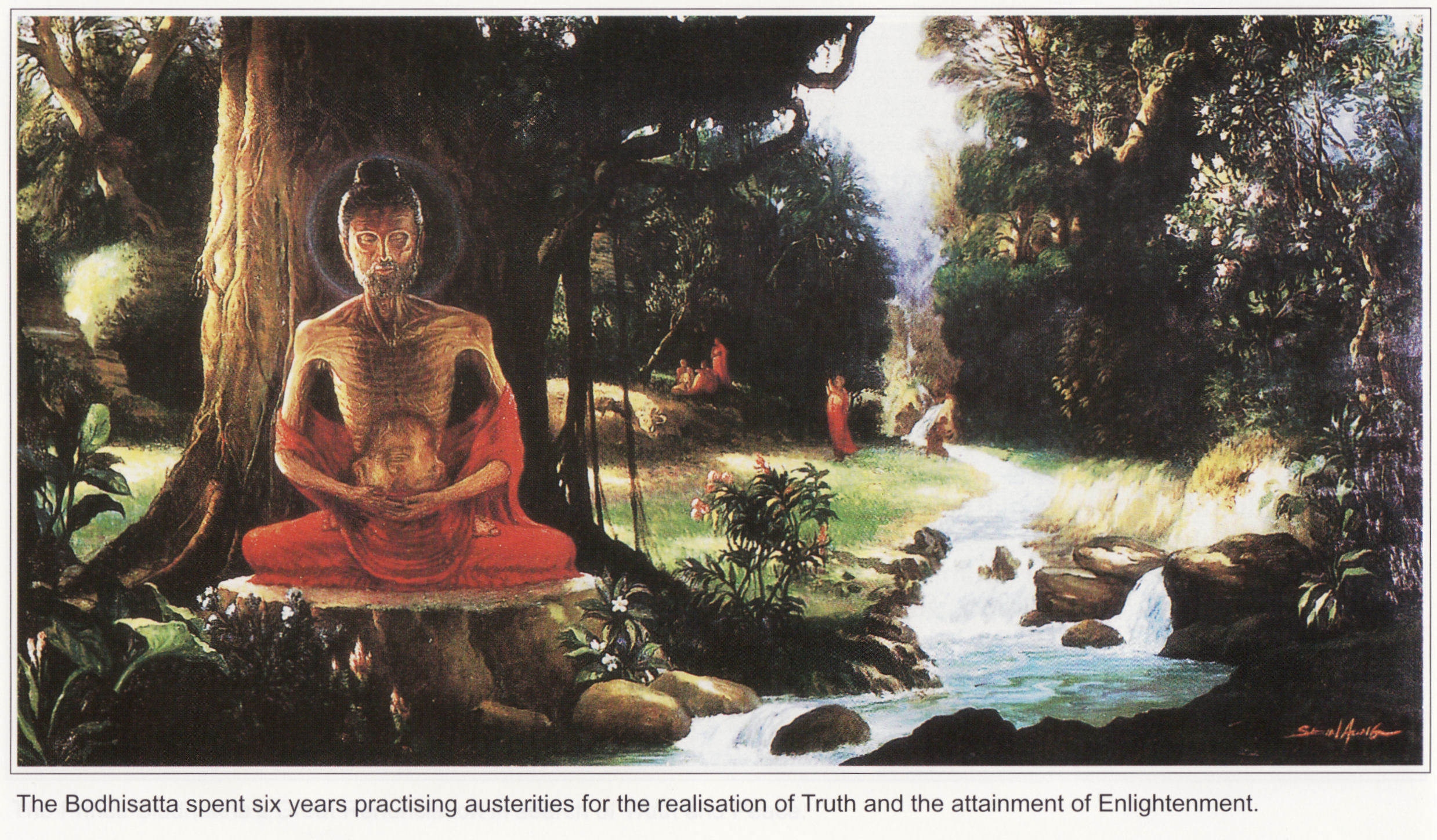 The ascetic Bodhisatta spent six years practising austerity and meditation with steadfastness as well as earnestness, prior to his attainment. Even though he was reduced to a mere skeleton, he did not give up practising.
.
.
 The Bodhisatta was sitting on a Golden Throne under a Bodhi tree and being challenged by Mara (the Evil One) riding on the ferocious elephant Girimekhala. Mara with host tried to capture the Golen Throne just before the Bodhistta’s Enlightenment.
.
.
 On Vesakha Full Moon day, Bodhisatta Siddhattha seated under a Bodhi tree at Gaya, attained Supreme Enlightement. On the first watch of the night he gained knowledge by which He remembered past lives. On the second watch of the night he was able to see into the future including the birth and death of other beings. On the third watch of the night, He destroyed all defilements and became a Fully Enlightened One (Samma-Sambuddha).
.
.
 It was in the final week (7th week) after his Enlightenment, when the two merchant brothers Tapussa and Bhallika from Ukkalapa passed by the spot and saw the Buddha. They offered the Buddha their own provision; then the Buddha gave eight strands of hairs from His head for them to worship as sacred objects of veneration.The hair relics are now enshrined in the Shwedagon Pagoda in Yangon, Myanmar.
.
.
 At the Deer Park at Varanasi, the Buddha met the five ascetics, Kondanna, Vappa, Bhaddiya, Mahanama and Assaji all of whom He had known before .He delivered His first sermon to them. It is called the Dhammacakkapavattana Sutta which sets the wheel of the Dhamma in motion. The ascetic Kondanna who was at His childhood Name-giving Ceremony became the first to see light in the Dhamma and attained Sotapanna, the first stage of Sainhood.
Later, all attained Arahantship after hearing the Anatalakkhana Sutta (the Discourse which deals with No-Self)
.
.
 The Buddha exhorted His first sixty Arahant disciples to go forth in different directions to preach the Doctrine, using these famous words: – “Go ye, 0 bhikkhus and wander forth for the gain of many, for the welfare of the many, in compassion for the world, for the good, for the gain, for the welfare of the Devas (Gods) and men . Proclaim ye, 0 Bhikkhus! The Doctrine that is glorious and preach ye a life of holiness, perfect and pure!”
.
.
 When the Bodhisatta visited Rajagaha, the capital of Magadha, King Bimbisara offered his Kingdom to the Bodhisatta. But He did not accept it because of the worldly pleasures. After listening to the preaching of Buddha, the King attained the first stage of Sainthood (Sotapanna). He then dedicated his Royal park known as Veluvana (Bamboo Grove) to the Buddha and His disciples.
.
.
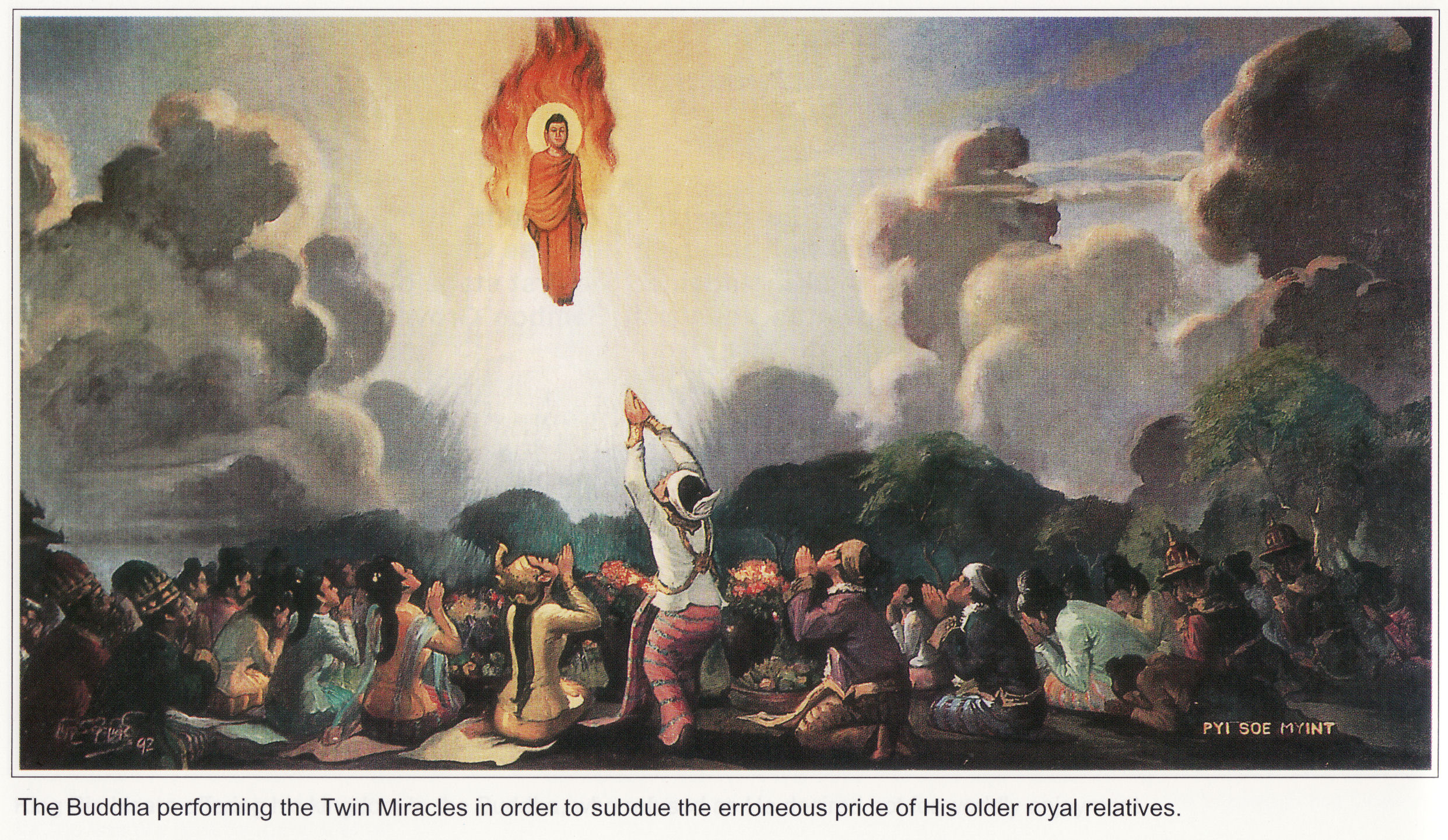 The Buddha performed the Twin Miracles of emitting fire and water simultaneously from His body, to subdue the pride of his older relatives who had erroneously thought that the Buddha being the younger would have to show respects to them.
.
.
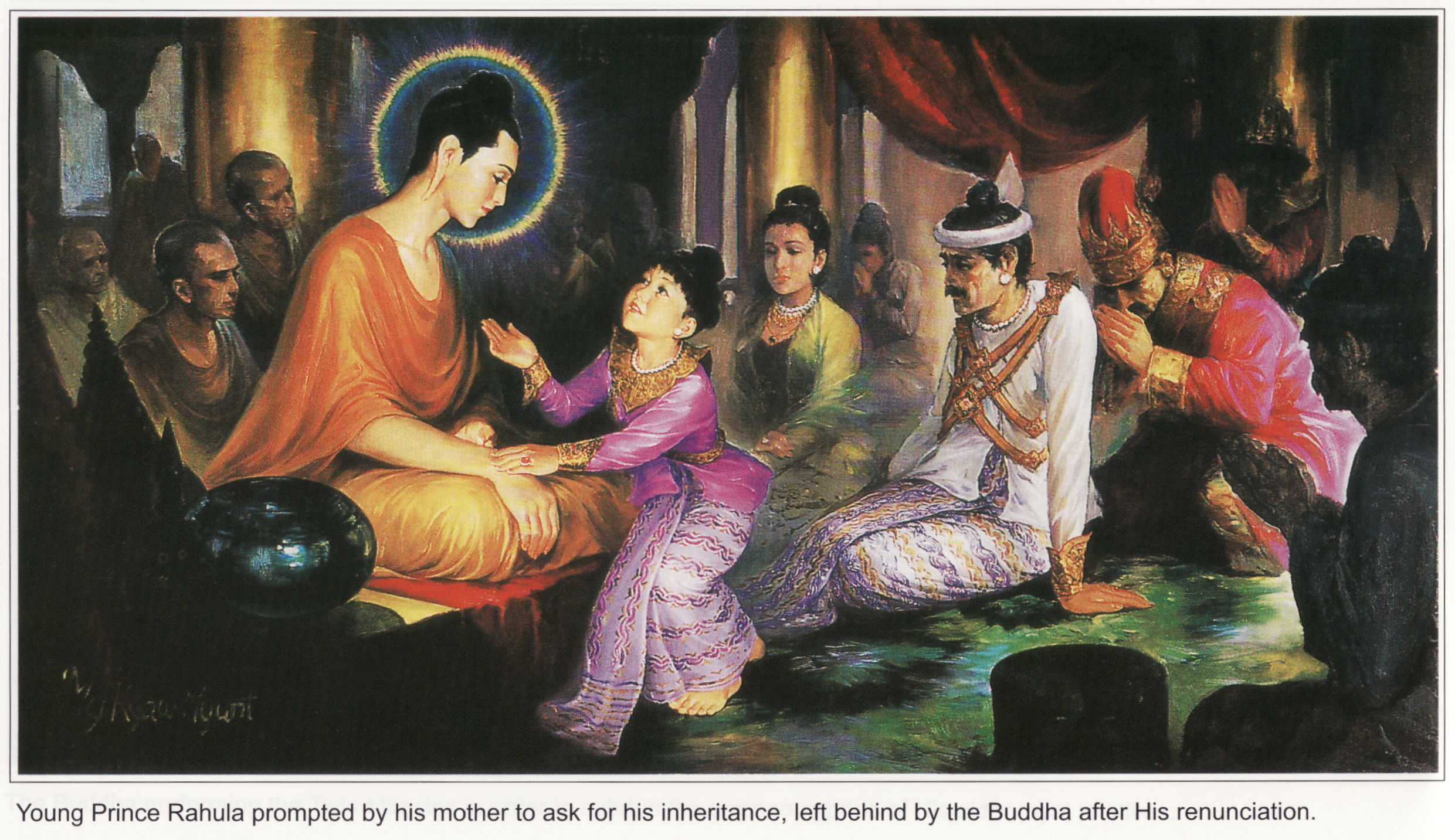 On the seventh day after his arrival in Kapilavatthu, Princess Yasodhara dressed up Prince Rahula and pointing to the Buddha said, “Behold, son, the great Ascetic of majestic appearance is your father. Go up to him and ask for your inheritance!”
As advised by his mother, young Rahula came to His presence and asked for his inheritance. Instead, the Buddha told Venerable Sariputta to ordain Prince Rahula , giving him a spiritual inheritance better than the one he asked for.
.
.
 During a subsequent visit to Rajagaha City, the Buddha went for alms-round in the company of His Chief Disciples and other monks. Along the way King Bimbisara and his royal family paid repects to the Buddha and His disciples.
.
.
 The Buddha delivering a sermon of peace to two powerful warning armies of Kapilavatthu and Koliya at the opposite banks of the Rohini river before the two countries started fighting for the water supply of the river, for pastoral use.
.
.
 The Order of Nuns (Bhikkhuni Sasana) was founded in the fifth year of the Buddha’s Enlightenment. After the death of King Suddhodana, Maha Pajapati Gotami , who was His former foster mother desirous of joining the Order ,approached the Buddha who was then, residing at Kapilavathu and begged permission for women to be admitted into the Order. After hearing and turning down their pleas, Buddha returned to Vesali for the Rains Retreat . Undaunted by the rebuff, Maha Pajapati Gotami cut off her hair and wearing yellow garments went on foot to Vesali, accompanied by many other Sakyan ladies. They stood outside the porch of the Pinnacled Great Hall in Mahayana where the Buddha was residing. Interceded by Venerable Ananda , the Buddha finally consented to establish the Bhikkhuni Sasana when Maha Pajapati Gotami and other Sakyan ladies agreed to observe the Eight Disciplinary Rules for nuns. Henceforth Maha Pajapati Gotami and other Sakyan ladies were admitted into the Order.
Later, the Nuns Khema and Uppalavanna were appointed the two Chief female Disciples; as were Sariputta and Moggalana the two Chief Male Disciples.
.
.
 After losing in lively debate, the haughty hermit Saccaka refused to answer accordingly when the Buddha asked a question. Only when he was threatened to be beaten up by a celestial demon for arrogance, only then did he finally realize his own folly and listened to the Buddha’s preaching meekly. This wholesome action of his would augur well for his future.
.
.
 On the seventh year after His Enlightenment, the Buddha preached the Abhidhamma (higher Doctrine) in Tavatimsa Heaven. As a fulfillment of gratitude to his former mother, now a Santussita deva, the Buddha then delivered a sermon on the Higher Doctrine to thousands of Devas (Gods) and Brahmas (higher celestial beings) who attained the various stages of Noble Sainthood.
.
.
 The non Buddhist sectarians grudgingly wanted to ruin the Buddha’s reputation. They told Cinca Manvika , a beautiful girl to falsely accuse the Buddha for her shamed, pregnancy in a big and august assembly. King of Devas (Gods) dispatched some Deities disguised as mice to gnaw through the strings holding a block of wood under her garment. Her plot was exposed when the wood fell on her feet. When the people saw that, they threw stones and chased her away. As she was walking away, the earth spilt open and a flame sprang up to envelop and drag her down to Avici (deepest and worst) Hell.
.
.
 On the sixteenth year of His Enlightment, the Buddha tamed the carnivorous Demon King , Alavaka who feasted on human flesh, to give up his habit on devouring at least one human being everyday. After hearing the Buddha’s Teaching, he henceforth gave up his habit, thus sparing the small child offered to him as food on that day.
.
.
 There was a young harmless student at TAKKASILA University called Ahimsa. His jealous fellow students poisoned the mind of their teacher against him. As a result the teacher asked Ahimsa for a garland of one thousand right index fingers as tuition fee. Eager to discharge his obligation, he went into the Jalini forest in Kosala and started to waylay the passing travellers to collect an index finger from the right hand of each victim. The garland was almost completed except for one more single finger. Ahimsa decided to kill even his own mother for the sake of completing the one thousandth finger in the garland. However, Ahimsa was intercepted by the Compassionate Buddha who came to his aid. After listening to His preaching and being convinced, Ahimsa now known as Angulimala (garland of fingers ) joined the Sangha and became a Bhikkhu (monk) . The Angulimala Sutta, a discourse ascribed to this Thera (elder/monk) and connected to this event, is well-known in Buddhist countries and often used by pregnant ladies in travail for easy and safe delivery.
.
.
 Once the Buddha and His Disciples went to Lake Anotatta passing by the mansion of Nandopananda the dragon king who was enjoying himself with his retinue. Angry at the apparent trespassing, Nandopananda coiled itself seven times round Mount Meru, covered the summit with its hood and spewing hot poisonous smoke to prevent the Buddha and his disciples from reaching lake Anotatta. Thereupon Maha Moggalana, (the second Chief Disciple) at once transformed himself into a dragon and likewise coiled round the mountain, crushing Nandopananda. Watched by the Buddha and His disciples, Maha Moggalana too began spewing hot poisonous smoke which greatly distressed Nandopananda who soon lost the challenge and upon realization of his folly, sought refuge in the Triple Gem of Buddhism.
.
.
 The Buddha taking care of a sick monk, named Tissa who had been neglected by his unthoughtful fellow monks. By so doing, the Buddha wanted to foster mutual care and welfare amongst the Bhikkhus as well as others.
.
.
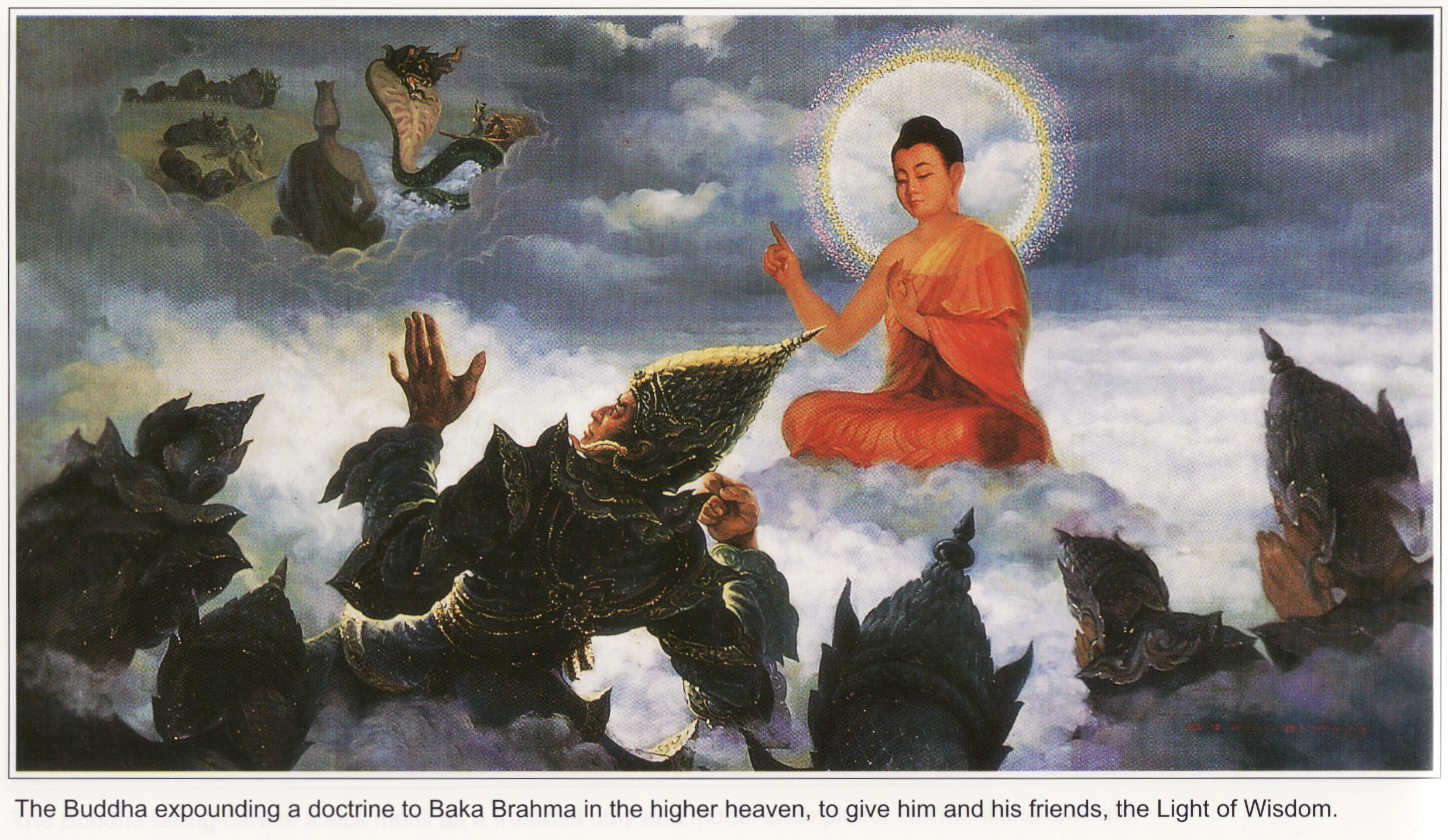 Baka Brahma, who was bitten by the snake of tenacious heresay (in believing that the Brahma Loka is the best and everlasting world in existence) , was duly defeated by the Buddha in a mutual contest to show power. On hearing the Buddha’s profound expounding of the Dhamma (Buddhist Doctrine), he became enlightened along with many other Brahmas (higher celestial beings).
.
.
 When the Buddha was on his way to the city of Rajagaha, Devadatta ordered the release of the fierce elephant, Nalagiri, to harm Him. As the elephant charged towards the Buddha, everyone ran away leaving a mother and her baby on the ground. The Buddha radiated His infinite Compassion to calm and subdued the elephant before it could trample the helpless baby.
.
.
 1. The Buddha at Kusinara laid himself between two Sal trees with his head to the North, determined not to rise again. He them delivered his last admonition, “Behold, 0 Disciples! I exhort you ! Subject to change are all component things! Strive on with Diligence !” before He entered Maha parinibbana (attainment of Final Emancipation).
2. Dona , the Brahman divided the Buddha’s relics into eight equal portions and distributed each of them to the Rulers of the eight countries. Then Dona decided that the golden container be kept for himself as an object of respectful veneration.
.
Tuesday, January 17, 2012
Just close your eyes and breathe.
It doesn't matter if you can't get a cell phone signal
or Wi-Fi where you are. You are always connected to Source.
I'm not kidding about this. I'm serious. Wherever you are,
wherever you go, you are always connected to Divine Wisdom,
Divine Intelligence, and Divine Love.
Just close your eyes. Breathe. Stop whatever you're doing
for ten seconds and find The Silence. Visit The Quiet.
Just for ten seconds. Do it six times today.
One minute a day. That's all it takes.
One minute, divided into six parts.
Go ahead. Do it now.
Love, Your Friend....

Neale Donald Walsch
Sunday, January 8, 2012
The loop of grace
The best (and only) way to truly give your gifts to others is unconditionally and quietly. The moment you start picking and choosing who you give to and why, using your gifts for selfish reasons, or making a parade or circus of your own talents and terrific goodness, you distort and even destroy the operation of grace. Instead, as Robert Barron writes, "The more we give back to God, the more we get, and then we must give that back again, so as to get even more in return. This is the loop of grace."
By Way of Beauty
The greatest wisdom is in simplicity.
"The greatest wisdom is in simplicity. Love, respect, tolerance, sharing, gratitude, forgiveness. It’s not complex or elaborate. The real knowledge is free. It’s encoded in your DNA. All you need is within you. Great teachers have said that from the beginning. Find your heart, and you will find your way.” ~ Carlos Barrios
Sunday, January 1, 2012
A Whole New World
Each time we read for enjoyment, the empathy awakened within us creates entire landscapes in our mind's eye.
Every book has the potential to touch the human soul deeply, arousing patterns of thought that might otherwise have lain dormant. The pleasure we derive from the written word is unique in that we must labor for it. Other forms of art provide us with stimulus and ask nothing more than our emotional response. Reading is an active pastime that requires an investment of emotion as well as our concentration and imagination. The words we read are merely a starting point for a process that takes place largely within our minds and hearts.
There are few activities as comforting, relaxing, and healthy as perusing the pages of a good piece of fiction or nonfiction. Curling up with a book and a cup of tea is one of the simplest ways we can remove ourselves from the confines of reality in order to immerse ourselves in the drama and intrigue of the unfamiliar. The pleasure of transcending reality is only one aspect of the reading experience, however. Each time we read for enjoyment, whether we prefer the fantastic nature of fiction, the empathy awakened within us by memoir, or the instructive passion of nonfiction, we create entire landscapes in our mind's eye. The books we choose provide us with the inspiration we need to accomplish such a feat, but it is our own creative reserves that empower us to use our imaginations for this unique and beautiful purpose.
The tales you lose yourself in can lead you on paths of discovery that take you out of your own life and help you see that existence can unfold in an infinite number of ways. You can learn so much from the characters and mentors who guide you from page to page. Your emotions are awakened each time you read, allowing you to become vessels of the passion that pours forth from line after line of print. Ultimately, the books you absorb—those that touch you deeply—will become a part of who you are, providing you with a rich and thrilling world within that you can revisit anytime you wish by simply closing your eyes. If you haven't read a book for pleasure lately, try and allow yourself the time—you deserve it.
Daily OM
Subscribe to:
Posts (Atom)